
The functional food market is no longer a niche.
The global functional foods market was estimated at $332 billion in 2024 and is expected to grow to $638 billion by 2034, at a CAGR of 6.9%. In North America alone, more than 65% of consumers reported in 2024 actively purchasing foods or beverages with a functional ingredient such as probiotics, vitamins, or adaptogens.
The numbers are not the problem. The evidence infrastructure behind the claims is.
The precise mechanisms by which bioactive compounds exert their effects are not fully understood, and health benefits often depend on compounds that vary widely in concentration and bioavailability, a gap that continues to hinder acceptance by healthcare professionals and serious buyers.
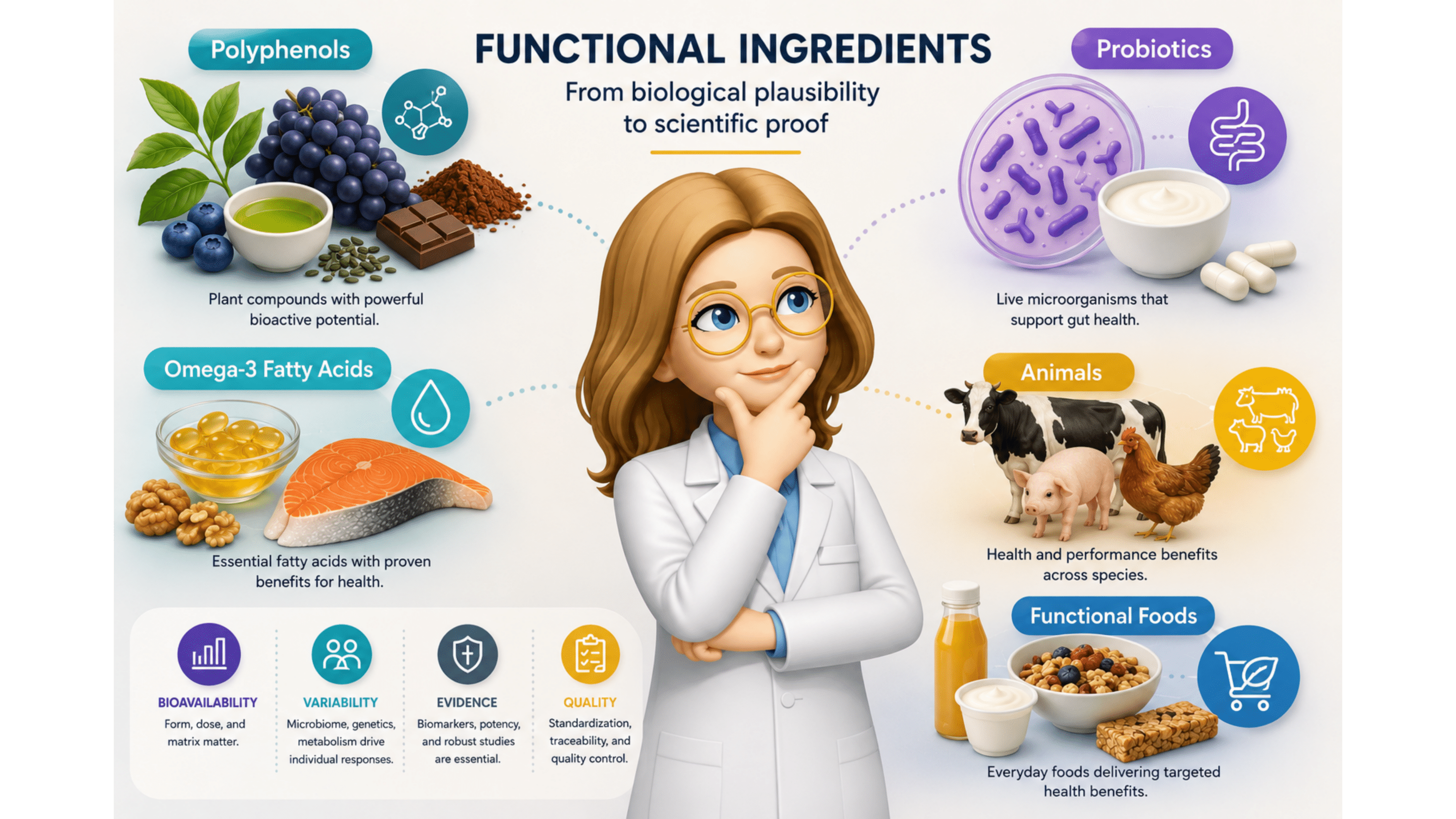
A market growing at double digits is not, by itself, evidence that the science is keeping pace. This newsletter examines three concrete ingredient categories through that lens.

Omega-3 fatty acids: the bioavailability problem in plain sight
Omega-3s are among the most studied bioactive compounds in nutrition. The biological rationale is solid. The methodological lessons are underused.
The bioavailability of EPA and DHA is a critical yet often overlooked factor influencing their efficacy. Bioavailability across isolated chemical forms follows a clear hierarchy:
1️⃣ NEFA
2️⃣ phospholipids
3️⃣ re-esterified triglycerides
4️⃣ unmodified TAG
5️⃣ ethyl esters.
This ranking matters, not as a commercial argument for one form over another, but because it establishes that the same active compound, in two different formulations, can behave as two different biological objects.
Yet significant differences observed in acute bioavailability studies often do not translate into long-term impacts. Methodological limitations, including inappropriate biomarkers, short sampling windows, and inadequate product characterisation, hinder the reliability and comparability of studies.
The biological picture reflects this. EPA-only formulations have shown significant reductions in cardiovascular disease outcomes in multiple trials, while low-dose EPA+DHA mixtures have routinely failed to prevent events in primary and secondary prevention settings. Same ingredient family. Opposite results. The difference lies in formulation, dose, and the biological specificity of the endpoint measured.
The lesson is not that omega-3s don’t work. It’s that the effect is formulation-dependent, dose-dependent, biomarker-dependent, and highly sensitive to inter-individual variability. Each of these variables requires characterisation at the preclinical level before any downstream claim can be built.
Polyphenols: promising biology, structurally unstable evidence
Polyphenols are among the most cited ingredient families in functional food research, and one of the clearest illustrations of the gap between biological plausibility and reproducible proof.
Only a small fraction of consumed polyphenols is absorbed in the small intestine. The majority reaches the colon, where it undergoes extensive microbial metabolism. The resulting metabolites, rather than the parent compounds, often exhibit the most profound biological effects.
This single observation has direct consequences for how studies should be designed. Gut microbiota vary significantly among individuals, and stratification by polyphenol-metabolising phenotype would be necessary in rigorous trials, since specific metabotypes produce the bioactive metabolites responsible for the observed health effects. Most published studies do not apply this stratification. They average across populations with fundamentally different metabolic responses, then report inconsistent results.
Bioactivity and bioavailability of polyphenols vary widely depending on food processing methods and gut microbiome composition, factors that alter the compound before it can exert any intended effect. When neither the ingredient nor the population is standardised, results cannot be stacked or compared across trials. The evidence accumulates without converging.
Animal nutrition: same science, higher stakes, weaker evidence base
The functional ingredient challenge is not exclusive to human health. The animal nutrition sector faces an identical methodological problem, compounded by antibiotic reduction pressure and the commercial demand for rapid, scalable results.
Persistent bottlenecks include heterogeneous responses across species and production contexts, narrow dose-response windows, interactions among multiple actives, limited evidence on long-term safety and carry-over into edible products, and fragmented regulatory pathways.
Bioactive content in plant extracts varies widely with raw-material source, extraction process, and storage conditions. Harmonised quality control frameworks, including chromatographic fingerprinting, bioactivity assays, and validated potency metrics, are critical for reproducibility and cross-study comparison.
Phytogenic feed additives including polyphenols, terpenoids, and alkaloids exert beneficial effects on animal health through modulation of oxidative stress and inflammatory pathways. Improvements in product quality, however, are primarily associated with enhanced antioxidant capacity rather than direct transfer of phytochemicals into animal-derived products, a distinction that matters considerably when building a biological claim.
One methodological development worth noting: intestinal models developed for human nutrition are now being applied in animal research. In vitro co-culture models have been used to assess the epithelial barrier effects of phytogenic feed additives, a convergence that opens the door to standardised preclinical characterisation across species, and to more comparable evidence bases across the two markets.
Four structural limitations, a critical synthesis

These limitations recur across all three ingredient categories, independently of the compound studied.
1) Bioavailability data is predominantly acute, and those differences rarely hold in chronic settings.
2) Endpoints are too often subjective or selected post-hoc, where mechanistically justified biomarkers should be the standard. Trials pool populations that respond very differently depending on microbiota profile, genetics, and metabolic status, diluting real effects into statistical noise.
3) And the ingredient itself is frequently unstandardised, making replication structurally impossible before the study even begins.
These are not isolated methodological failures. They are the systematic reasons why a market growing at double digits continues to produce evidence that doesn’t stack.
To support and structure this article, the following peer-reviewed scientific publications were used as primary sources of information
Alijani S, Richardson CE, Schmidt EB, et al. Bioavailability of EPA and DHA in humans: A comprehensive review. Progress in Lipid Research. 2025;97:101318. doi:10.1016/j.plipres.2024.101318.
Sherratt SCR, Mason RP, Libby P, Bhatt DL. Do patients benefit from omega-3 fatty acids? Cardiovascular Research. 2023;119(18):2884–2901. doi:10.1093/cvr/cvad188.
Bernhard B, Heydari B, Abdullah S, Francis SA, Lumish H, Wang W, Jerosch-Herold M, Harris WS, Kwong RY. Effect of six month’s treatment with omega-3 acid ethyl esters on long-term outcomes after acute myocardial infarction: The OMEGA-REMODEL randomized clinical trial. International Journal of Cardiology.2024;399:131698. doi:10.1016/j.ijcard.2023.131698.
Mahdi L, Graziani A, Baffy G. Unlocking Polyphenol Efficacy: The Role of Gut Microbiota in Modulating Bioavailability and Health Effects. Nutrients. 2025;17(17):2793. doi:10.3390/nu17172793.
Lippolis T, Cofano M, Caponio GR, et al. Bioaccessibility and Bioavailability of Diet Polyphenols and Their Modulation of Gut Microbiota. International Journal of Molecular Sciences. 2023;24(4):3813. doi:10.3390/ijms24043813.
Tomás-Barberán FA, Selma MV, Espín JC. Interactions of gut microbiota with dietary polyphenols and consequences to human health. Current Opinion in Clinical Nutrition and Metabolic Care. 2016;19(6):471–476. doi:10.1097/MCO.0000000000000314.
Buonaiuto G, Danese T, El-Sabrout K, Yıldırım A. Bioactive feed additives in animal nutrition: bridging innovation, health, and sustainability. Frontiers in Veterinary Science. 2025;12:1727126. doi:10.3389/fvets.2025.1727126.
Contò M, Castrica M, Balzaretti CM, et al. Natural Bioactive Compounds as Feed Additives: Strategies for Sustainable and Functional Livestock Production. Applied Sciences. 2026;16(5):2344. doi:10.3390/app16052344.
Wendner D, Schott T, Mayer E, Teichmann K. Beneficial Effects of Phytogenic Feed Additives on Epithelial Barrier Integrity in an In Vitro Co-Culture Model of the Piglet Gut. Molecules. 2023;28(3):1026. doi:10.3390/molecules28031026.
Grand View Research. Functional Foods Market Size Worth $586.1 Billion By 2030. Grand View Research; 2022